

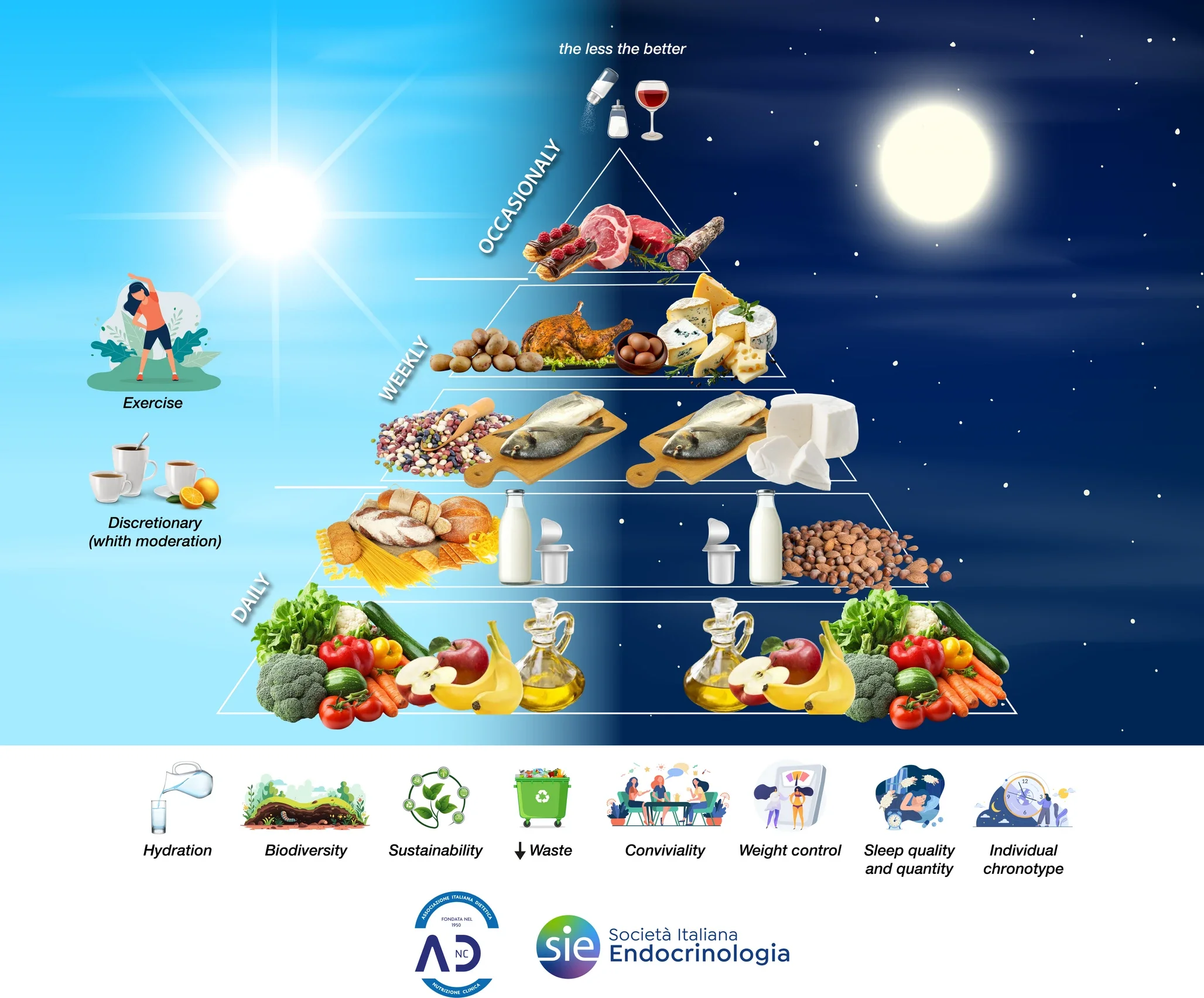
The Mediterranean Diet has long been considered one of the most scientifically sound dietary models. Its benefits for cardiovascular health, metabolism, longevity, and brain function are widely documented. However, for years the focus has been almost exclusively on what to eat: foods, consumption frequency, portions.
Today, research invites us to add a new, equally crucial question: when do we eat what we eat?
In recent years, an emerging discipline has gained ground: chrononutrition, which studies the interaction between nutrition and biological rhythms. In this context, a recent review published in Current Nutrition Reports proposes an updated Mediterranean Diet pyramid based on chronotype, integrating nutrition, chronobiology, and lifestyle.
Circadian rhythms: time as a metabolic regulator
Our body is governed by a sophisticated system of biological clocks. The most well-known is the central circadian clock, located in the hypothalamus, but every tissue has “peripheral clocks” that regulate fundamental functions such as glucose metabolism, hormone secretion, digestion, and inflammatory response.
Eating at times not aligned with these rhythms – for example, concentrating most caloric intake in the evening or at night – can alter insulin sensitivity, promote a chronic inflammatory state, and interfere with sleep quality. So it’s not just a matter of calories or nutrients, but of biological synchronization.
The role of chronotype: we are not all the same
A central element of the new proposed pyramid is the chronotype, that is, the individual predisposition to be more active and alert in the morning or in the evening. There are naturally morning people and evening people, with significant differences in hunger regulation, metabolic response to meals, and eating habits.
Numerous studies show that evening chronotypes tend more frequently to:
- delay meals,
- skip breakfast,
- consume more energy in the evening hours,
- have lower adherence to the traditional Mediterranean Diet.
Taking chronotype into account does not mean “justifying” dysfunctional habits, but personalizing nutritional strategies to make them more sustainable and physiologically coherent.
A new Mediterranean pyramid: what really changes
The Mediterranean Diet is not overturned in its fundamental principles. Plant foods, whole grains, legumes, fish, extra virgin olive oil, and a moderate presence of animal proteins remain central. What changes is the temporal distribution of nutrients.
The new representation suggests:
- favoring complex carbohydrates and fiber in the early hours of the day, when insulin sensitivity is higher;
- progressively shifting a greater share of protein intake towards the evening, which is also useful for satiety and supporting the sleep-wake rhythm;
- maintaining quality fats as a transversal element, adjusting their quantity and timing.
At the base of the pyramid are not only foods, but also lifestyle, meal regularity, light exposure, physical activity, and sleep quality, recognizing that nutrition never acts in isolation.
Why this approach is relevant today
Integrating chrononutrition and the Mediterranean Diet represents a real paradigm shift. It means moving beyond the “one size fits all” model and recognizing that metabolic and neurological health also depends on respecting individual biological timing.
This approach can be particularly useful:
- in the prevention of metabolic diseases,
- in improving long-term adherence to dietary plans,
- in supporting people with irregular rhythms, shift work, or evening chronotypes,
- in promoting a kinder and less guilt-inducing view of eating.
Eating well is not just about choosing healthy foods, but learning to communicate with your internal clock.
Conclusions
The Mediterranean Diet continues to evolve, not losing its identity but enriching itself with new knowledge. Time becomes a true nutritional factor, capable of modulating the effects of food on our bodies. Perhaps the right question today is not only “am I eating well?”, but also “am I eating at the right time for me?”
Barrea, L., Muscogiuri, G., Laudisio, D., Pugliese, G., de Alteriis, G., Savastano, S., & Colao, A. (2026).
A novel chronotype-based Mediterranean diet pyramid: An updated representation by the Italian Society of Endocrinology (SIE) and the Italian Society of Dietetics and Clinical Nutrition (ADI).
Current Nutrition Reports.
https://doi.org/10.1007/s13668-026-00731-x